
I’m always excited to have a new paper out—new ideas out there making their own way in the world—but this one feels especially meaningful to me because it sits at a crossroads I’ve been thinking about for a long time: the gap between the mathematical theory of epidemics (elegant as it is) and the stubborn complexity of human behavior.
Part of that sharpened for me during my time in Oxford, when I got to know Jasmina Panovska-Griffiths and Andrés Colubri. We spent a lot of time talking about the same problem from different angles—modeling, behavior, networks, public health, realism, evidence—and those conversations stayed with me. I want to be careful here not to overstate my own role: Jasmina and Andrés are leading important work in this area, and many others have been thinking seriously about this space for a long time. What I took from those conversations was a clearer sense of the gap: epidemic science does not lack theory or computational sophistication so much as good empirical tools for understanding behavior in the social settings where transmission happens.
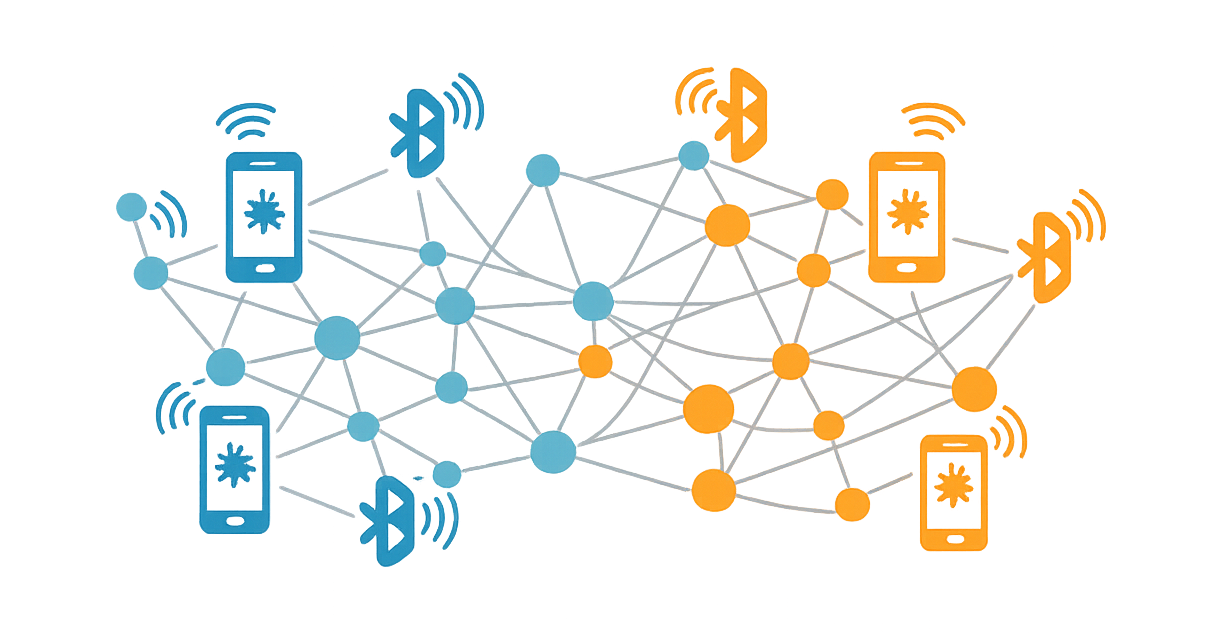
That is the motivation behind our new comment in Nature Health on “epigames”. The basic idea is to use smartphone-based, gamified epidemic field experiments to generate the kind of data we often wish we had: dynamic contact patterns, behavioral decisions, social influence, attitudes, and context, all measured together instead of in separate studies that never quite line up.
What I find exciting is the possibility of studying a simulated pathogen spreading through real proximity networks while participants make decisions in the app—whether to isolate, whether to vaccinate, how to respond to risk, what to do when peers behave differently. For modelers, that could be a much better empirical foundation than the usual patchwork of contact diaries, surveys, and observational traces from mismatched settings.
At the same time, the limitations are real and worth saying plainly. People know they are playing a game, and that almost certainly affects behavior. The contact patterns may be quite realistic, but it is harder to know how well gamified choices capture real-world decisions about vaccination or isolation, where stakes, constraints, and social pressures are different. This approach is also most naturally suited to acute infections with short generation times, where rapid interactions and behavioral responses are central to transmission.
Even with those caveats, I think epigames could be enormously useful—especially if they are deployed across a wide range of settings. One of the most promising possibilities is simply learning more about structured human movement and interaction in schools, workplaces, campuses, and other meso-scale environments where a great deal of epidemic dynamics actually unfolds.
More broadly, this work pushes epidemiology into a richer conversation with the empirical social sciences, which is exactly where we need to be. Pandemic preparedness is not only about virology, immunology, or surveillance capacity. It is also about institutions, incentives, trust, peer effects, and the structure of everyday interaction. Those are not side issues; they are part of the transmission process.
So yes, I’m excited to have the paper out. If you’d like to read it and can’t access the journal version, email me and I’m happy to send a PDF. But what matters more to me is what it opens up. If this line of work develops well—and if we stay clear-eyed about its limits—it could help build a stronger empirical foundation for epidemic theory, especially in the structured social settings where so much transmission actually happens. That would be a real advance: not a replacement for the tools we already have, but a way to make them more realistic about the human part of epidemics.